
You Never Know Who Kept Going Because You Did
When a woman leads in plain sight, the women and girls watching her change what they believe they can do. The evidence shows how far that reaches, and how seldom the woman at the front knows it.
Written in honour of Ciara Mageean.
Somewhere this evening a girl is pulling on her boots in the dark to play or train before heading back to school tomorrow. She might be heading for a yard, a track or a pitch. Whether she is still doing it in five years will depend on many things, and one of them is whether she has watched a woman do it first. That woman will almost certainly never find out.
Billie Jean King has spent a lifetime making the case for women in sport, and she keeps coming back to one simple idea: "If you can see it, you can be it." This year she gave that idea a book of its own, See It To Be It, written with Liz Robbins. The line travels because it is true to life. Before we try something, we tend to look for someone like us who already has.
What the map shows
Zoom out and the same pattern turns up in places with very little else in common.
In 1993, India passed a law reserving the leadership of randomly selected village councils for women. That handed researchers something rare, a fair comparison. In a study published in Science in 2012, the economists Lori Beaman, Esther Duflo, Rohini Pande and Petia Topalova analysed 8,453 surveys of young people aged 11 to 15 and their parents, across 495 villages in West Bengal. Where a woman had led the council for two election cycles, compared with villages that never had one, the gap between what girls and boys hoped to become narrowed by 32 per cent among the young people themselves. The gap in their schooling closed completely, and girls spent less time on household chores. The jobs open to young women in those villages stayed the same. The authors traced the difference primarily to a role model effect: the girls had watched a woman run the village, and they raised their sights to match.
It can take remarkably little. At Southern Methodist University in Dallas, the economists Catherine Porter and Danila Serra arranged for two women who had majored in economics there to speak to introductory economics classes for 10 to 15 minutes about their experience and what the degree had done for them. The women in those classes became eight percentage points more likely to choose economics as their degree, against a starting point of about nine per cent. The study was published in the American Economic Journal: Applied Economics in 2020. A short talk from women who had already done it moved a decision that shapes a working life.
Ireland ran its own version in public. The 20x20 campaign, driven by the Federation of Irish Sport and launched in October 2018, set out to make women in sport more visible, on exactly that logic.
The women at the top of Gaelic football show how far the picture has moved. In December 2024 the Ladies Gaelic Football Association surveyed 100 inter-county players. Thirty-seven per cent said they had looked to male sports stars as their role models growing up. Now, the LGFA reported, just two per cent say they currently have a male sports role model. Somewhere between childhood and the county jersey, the women they could look up to came into view.
That matters most in the teenage years, when a girl decides whether sport is still for her. Canadian Women & Sport's 2024 Rally Report found that more than one in five girls leave sport during adolescence, with the drop-off rising from the age of 16 and speeding up through the late teens. Those are the years when seeing a woman in her own sport can matter most to a girl.
The part nobody sees
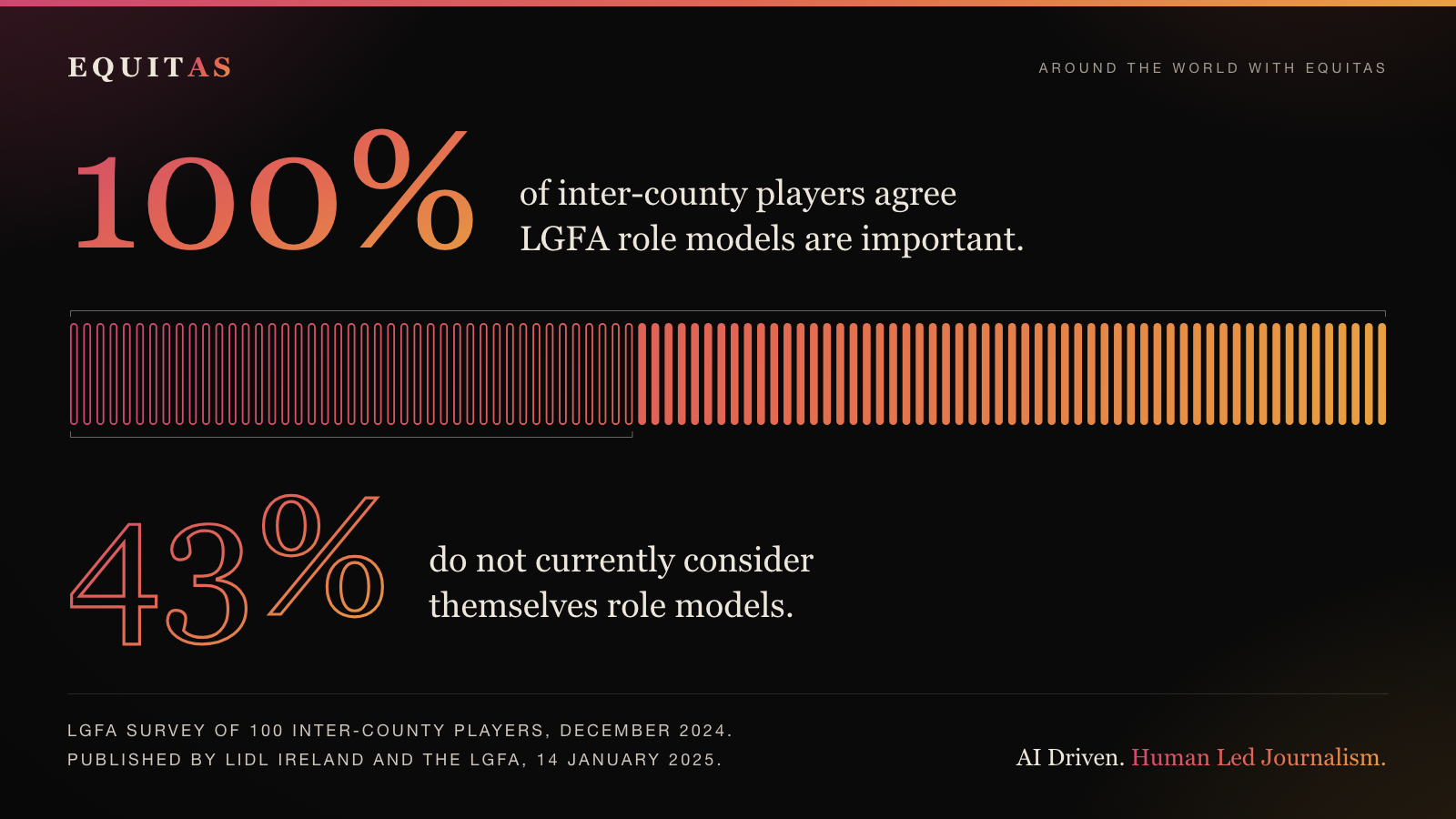
The influence flows outward from the woman at the front, and she rarely feels it. In that same LGFA survey every player agreed that having LGFA role models is important, and 43 per cent said they did not currently consider themselves to be role models. These are inter-county players, and more than four in ten of them do not see themselves that way.
That gap, between how a woman sees herself and how she is seen, is where so much of the good gets done. She turns up at the yard at six on a January morning. She takes on the young horse nobody else wants to ride. She sits in the meeting and says the thing the whole room was thinking. She does it for her own reasons, and a girl at the gate takes something from it that neither of them could name. The girl keeps going, and years later someone is watching her.
This is the byproduct, and it compounds. One woman who keeps going gives a girl permission to keep going, and that girl grows into the woman someone else is watching. It runs through village councils, lecture halls, dressing rooms and yards. It rarely shows up in a results table, and it outlasts every one of them.
Maya Angelou understood this better than most. She had one son, and she dedicated Letter to My Daughter to the daughter she never had. "I gave birth to one child, a son," she wrote, "but I have thousands of daughters." The reach of a woman who leads in plain sight is counted that way, in daughters.
The racing world has watched it happen. In 2021 Rachael Blackmore won the Aintree Grand National on Minella Times, the first woman to ride the winner of the race. Asked in January 2025 about the young girls and boys who came up to her at the races, she told the Irish Examiner: "I hope I can continue to inspire them. It's a real privilege to be in that position."
That is the power in all of this, and it sits in ordinary hands. Every woman who coaches, rides, judges, trains or runs a yard is already on show to someone younger, whether she feels it or not. Clubs, federations and the media decide how many of those women a girl gets to see, and every one of them can choose to show more. Equitas exists to show more of them.
For Ciara Mageean
On 14 January 2025, the day the LGFA published those findings, one of the athletes on its launch panel was Ciara Mageean. Seven months earlier, in Rome, she had become European 1500m champion, the second Irish athlete after Sonia O'Sullivan to win an individual gold at the European Athletics Championships.
"As athletes, we have the opportunity to inspire the next generation, not only through our achievements but also by fostering a community where young girls can see themselves as champions," she said in the launch statement. Asked by RTÉ Sport about being a role model, she was honest about how it felt. "It's probably something that whenever people ask there's a little bit of, 'who me?'" Then she said what she believed it asked of her: "Every time I step out there I represent myself, the whole of our nation and every little girl that's following behind me."
In July 2025 she told the public she had cancer. "I'm ready to face this with the same fight I've always brought to the track," she wrote. She went on to tell her story in a memoir, My Greatest Race. She died on Sunday, 1 November 2026, aged 34. A statement on her Instagram account that day read: "A beloved daughter, sister, wife, friend and inspiration to so many, she will be deeply missed." Athletics Ireland said: "Her courage, warmth and spirit will leave a lasting legacy."
Ciara asked "who me?" and then answered her own question: every little girl following behind her. Most of them she never met, and none of them will ever be counted, and she never needed their names for it to be true. Every woman reading this is a role model to someone, whether she knows it or not.
Equitas dedicates this piece to Ciara Mageean.
Ar dheis Dé go raibh a hanam.