
Allies in the yard: what good support looks like
You don't have to be LGBTQIA+ to care about inclusion in equestrian sport. In fact, some of the most meaningful progress in any community comes not from those most directly affected, but from the people around them who choose to show up.
Allyship in an equestrian context doesn't require grand gestures. It doesn't require a speech, a deep theoretical understanding of every aspect of LGBTQIA+ identity, or a perfectly calibrated response to every situation. It requires paying attention, and being willing to act on what you notice.
Here is what good support actually looks like, from the everyday to the structural.
In the yard
The simplest form of allyship is language. Using someone's correct name and pronouns, consistently and without making it a production, is the baseline. Getting it right sends a signal that this person belongs here. Getting it wrong - repeatedly, or dismissively - sends an equally clear signal in the other direction.
It also means not laughing at the jokes you wouldn't find funny if the person they're aimed at was standing next to you. That's not complicated. That's just kindness.
Allyship in an equestrian context doesn't require grand gestures. It requires paying attention, and being willing to act on what you notice.
In conversation
There's a meaningful difference between genuine curiosity and making someone your personal education project. Most LGBTQIA+ people are happy to talk about their experiences when those conversations develop naturally - but they shouldn't have to carry the weight of representing an entire community every time the subject arises.
Good allies listen more than they speak. They hold space for experiences that aren't theirs. And when they don't know something, they say so, and then go and find out, rather than asking someone who is already doing the emotional labour of existing in a space that wasn't designed with them in mind.
The internet has plenty of resources. Use them first.
In competition
Competitive environments can feel particularly exposing for LGBTQIA+ riders, especially in disciplines with strong traditional cultures. Being a visible ally in those spaces matters more than people realise, not because it requires dramatic intervention, but because visibility itself is protective.
That might mean challenging a comment from a fellow competitor. Or simply making sure an LGBTQIA+ rider on your team knows you're in their corner. Small signals accumulate. So do their absences.
If you run a yard or club
This is where structural allyship begins, and where individuals often have the most leverage.
Clear codes of conduct that explicitly include LGBTQIA+ protections aren't just good governance. They signal, before anyone has to ask, what kind of space this is. If your code of conduct is vague about inclusion, that ambiguity isn't neutral, it falls on the people who most need clarity to navigate it.
Facilities matter too. Where possible, gender-neutral or clearly signposted changing spaces remove a friction point that LGBTQIA+ riders encounter at every venue. It doesn't always require a renovation. It sometimes just requires a decision.
The honest bit
None of this requires you to get everything right all of the time. It requires you to prioritise getting it right over protecting yourself from getting it wrong.
That distinction, valuing the other person's experience over your own discomfort, is where allyship actually lives.
Equestrian sport belongs to everyone in it. Allies are the people who keep making that true.
Equitas is committed to covering inclusion in equestrian sport throughout the year — not just in June. If you have a resource, story, or perspective to share, we'd love to hear from you.
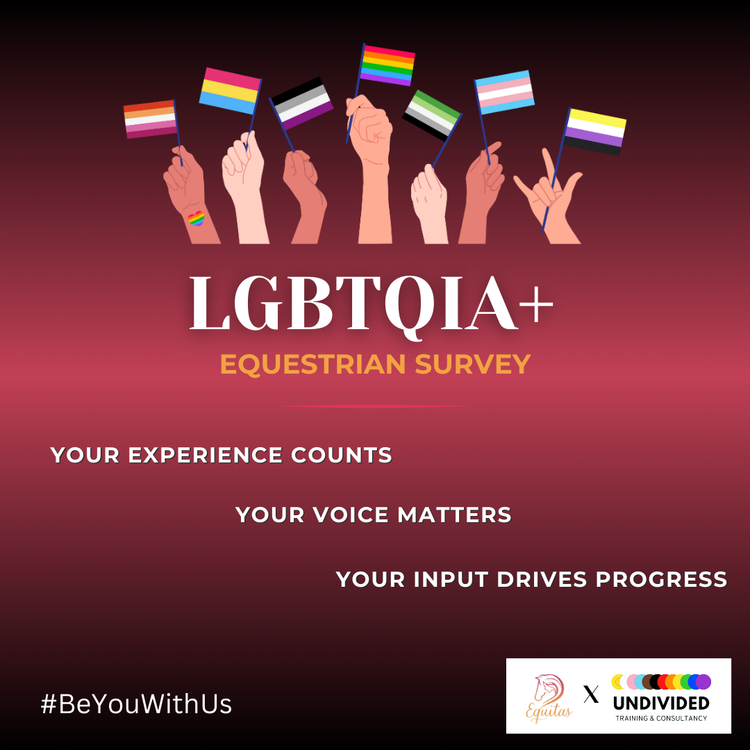
We're also running an anonymous LGBTQIA+ Equestrian Community Survey — it takes 5 minutes and every response helps. Take it here →