

Busy isn't a reason: what chronic stress is doing to you, and where to start
It's Stress Awareness Week (2–6 November), and if you're reading this between mucking out, the school run and a full inbox, this one is for you.
Katie Pinn, The Equestrian Psychotherapist (@the_equestrian_psychotherapist), has marked the week with a post that skips the usual advice. As she puts it, she's "not telling you to have more bubble baths." Instead, it's a clear look at what stress does to the body and brain, and a practical way to work out where yours is actually coming from.
Katie is a therapist and psychological coach who works with riders. She is a registered member of the British Association for Counselling and Psychotherapy (MBACP), holds an MSc, and is an equestrian herself.
Stress isn't the enemy. Staying stressed is
Some stress is useful. Katie points out that there is even a positive kind, called eustress, that motivates us. Our bodies are built to switch on a stress response when there's a threat, deal with it, and then return to rest.
The problem is modern life. Emails, notifications, money worries, career uncertainty and traffic don't need us to fight or run, but they trigger the same systems in the body. And because these pressures never really stop, the stress system never fully switches off. It stays running on standby.
What chronic stress does to the body and brain
When stress hormones such as adrenaline and cortisol stay high for a long time, they stop being a helpful short-term boost. Katie explains that they start to disrupt the immune system, the metabolism and the heart and blood vessels. The American Institute of Stress cites an estimate that 75 to 90 percent of visits to primary care doctors are for stress-related problems. It's a widely quoted figure rather than a precise measurement, but it shows how much stress sits behind everyday ill health.
The brain changes too. Research shows that long-term stress weakens the areas we use for planning, decisions and memory, while strengthening the brain's threat detector, the amygdala. In everyday terms, that can mean feeling more on edge, more reactive and less able to think clearly, and more vulnerable to anxiety and low mood.
The bill comes due
Katie is honest that this can be hard to read. Many of us are very good at normalising discomfort and pushing through. But, as she says, your body is keeping score.
Doctors call the build-up of wear and tear from long-term stress allostatic load. Katie describes it as an engine overheating: you might feel constantly wired, snappy and anxious, or the opposite, shut down, exhausted and foggy. Burnout is the engine breaking down completely, a deep physical, mental and emotional exhaustion.
Why this matters for equestrians
Riders often carry an extra load that other people don't see: early mornings and late evenings at the yard, horse care in every kind of weather, vet bills, competition nerves, and fitting it all around work and family. For many of us, the horses are what keep us going. But when time with them turns into one more thing to get through, that's worth noticing.
Where to start: the Stress and Energy Drain Wheel
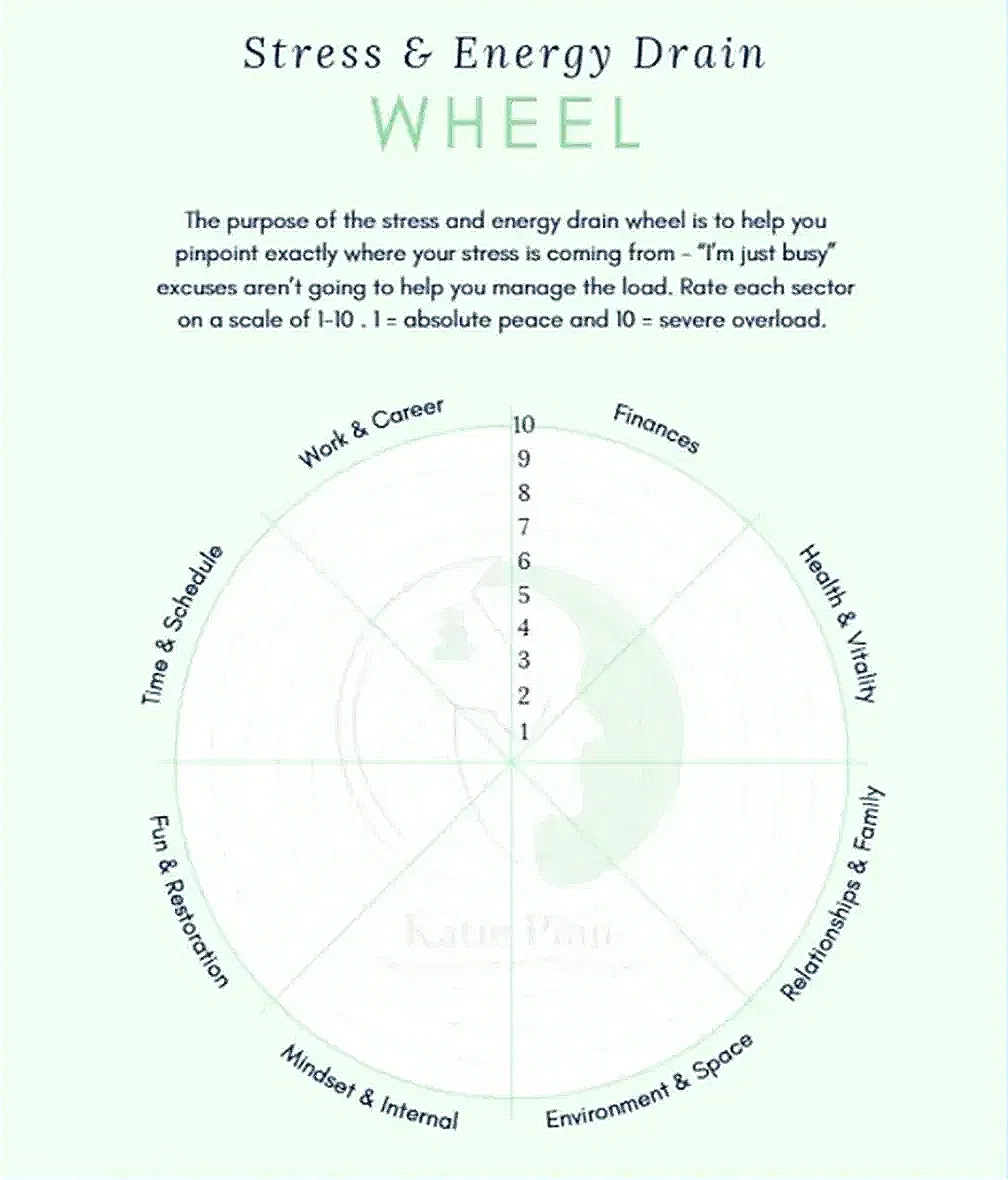
Katie has adapted a well-known coaching exercise, the wheel of life, into a tool she calls the Stress and Energy Drain Wheel. The idea is simple: "I'm just busy" doesn't tell you what to change, so the wheel helps you see exactly where the pressure is coming from.
You score eight areas of your life from 1 (complete peace) to 10 (severe overload):
- Work and career: workload, lack of control
- Finances: money worries, bills, unpredictability
- Health and vitality: pain, poor sleep
- Environment and space: clutter, a stressful commute
- Relationships and family: conflict, lack of support
- Time and schedule: always rushing, saying yes to too much
- Mindset: perfectionism, negative self-talk
- Fun and restoration: too little joy, hobbies or real downtime
Next to each score, note why you gave it. Then pick one area and ask yourself, as Katie suggests: if this is a 7, what would it take to bring it down to a 6 or a 5? What one change could you make?
Looking after you
When stress is high, our instinct is often to drop the things that look after us. Katie's advice is to do the opposite and build a buffer. That doesn't only mean pampering. It means being honest about whether we're doing things that harm us under stress, and actively looking after ourselves, from emotional self-care, like therapy or having somewhere to talk, to financial self-care, like setting a budget and sticking to it.
Get the wheel
Katie is offering her Stress and Energy Drain Wheel template for free. Email enquires@katiepinnisc.com or send her a DM on Instagram with the words STRESS WHEEL. You can find out more about her work at katiepinnisc.com.
If stress is affecting your health, talk to your GP. If you're in crisis, contact your local emergency services.
This article draws on a post by Katie Pinn, The Equestrian Psychotherapist, shared with thanks.